ADAS Calibration — Static & Dynamic — Michigan, Indiana & Illinois
Advanced Driver Assistance Systems (ADAS) — lane departure warning, forward collision alert, automatic emergency braking, adaptive cruise control, and traffic-sign recognition — rely on cameras and sensors that are mounted to or aligned through your windshield and surrounding glass. When that glass is replaced, removed, or even shifted, the camera's reference point changes and the system must be recalibrated to the manufacturer's specification before the safety features can be trusted. Skyview Auto Glass performs both static and dynamic ADAS calibration, following the documented procedures for your vehicle's make, model, and model year. Because calibration requirements and availability depend on the vehicle and on manufacturer procedures, we confirm exactly what your specific car requires before scheduling.
Our credentials: Skyview Auto Glass is a Registered Member Company of the Auto Glass Safety Council (AGSC), and our technicians are certified by the National Windshield Repair Division (NWRD), hold Automotive Service Excellence (ASE) certification, and carry DINITROL Glass Replacement certification. See our certifications.
Every installation is backed by our lifetime workmanship warranty.
Why Choose Skyview for ADAS Calibration?
- Both static and dynamic ADAS calibration performed to manufacturer procedure
- Forward camera, lane-keeping, and emergency-braking alignment verified before release
- Correct target set and diagnostic software confirmed against your VIN
- Calibration completed in the same appointment as your windshield replacement
- Honest assessment — we tell you if your vehicle does not require calibration
- No vehicle released with an outstanding ADAS calibration fault
- Lifetime workmanship warranty and direct insurance claim handling
What Is ADAS Calibration and When Is It Needed?
ADAS calibration is the process of realigning the cameras and sensors that feed your vehicle's driver-assistance features to the manufacturer's exact geometric and software specification. Calibration is typically required after a windshield replacement (because the forward camera is bonded to or optically referenced through the glass), after a collision or structural repair, after suspension or wheel-alignment changes that alter vehicle ride height, and sometimes after a battery disconnect that resets the camera module. Not every vehicle requires calibration after every glass job — it depends on the ADAS features installed, the camera mounting design, and the manufacturer's published service procedure. Advanced driver assistance systems (ADAS) span a range of features — forward collision warning, automatic emergency braking, lane departure warning, adaptive cruise control, and blind spot monitoring — each fed by ADAS sensors and cameras mounted at specific points on the vehicle. The forward-facing camera behind the windshield is the ADAS component most often disturbed by a glass replacement, which is why windshield-driven ADAS recalibration is the most common calibration we perform. Skyview identifies whether your vehicle requires calibration and which type, confirmed against your VIN and option package, before any work begins.
Static Calibration — What It Is and How It Works
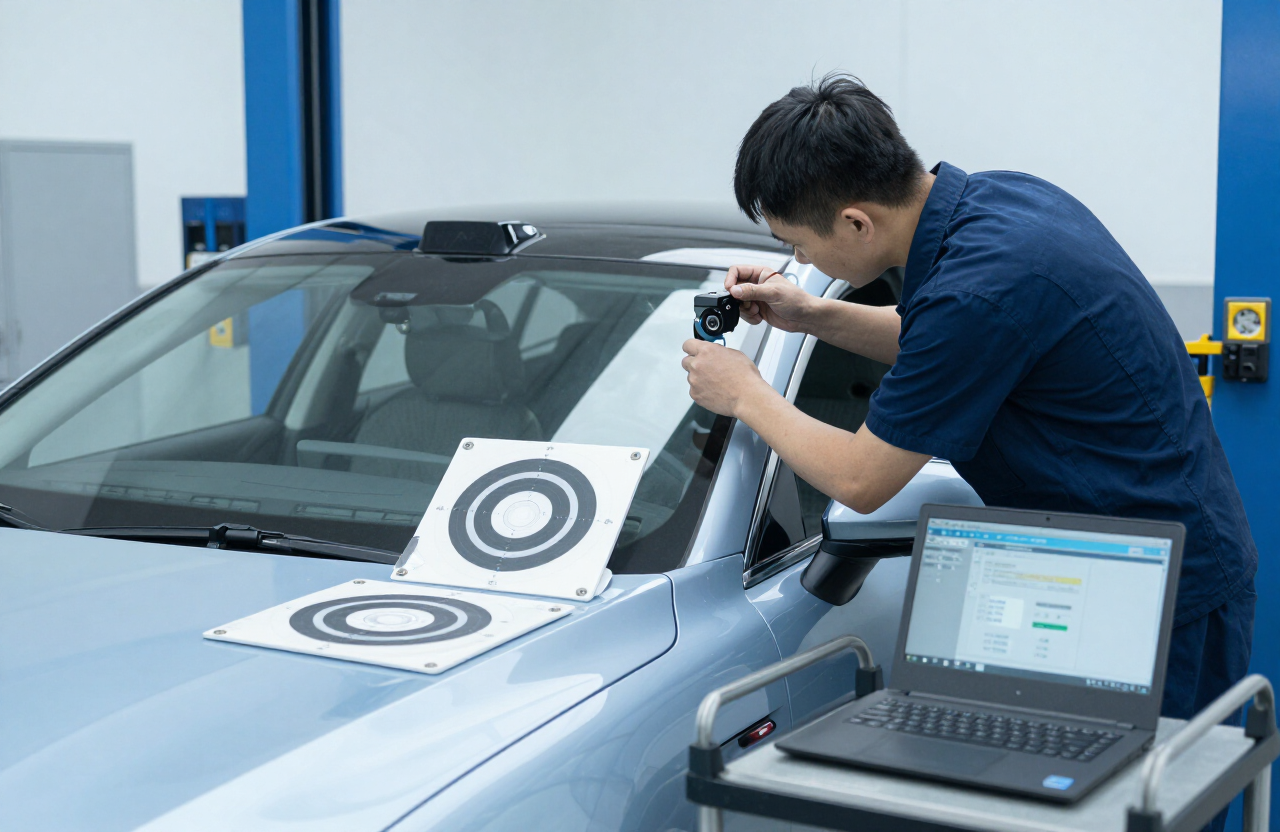
Static calibration is performed in a controlled, level environment using a set of manufacturer-specified optical target boards placed at precise distances, heights, and angles in front of the vehicle. The calibration software guides the technician through a sequence of measurements while the vehicle sits stationary, and the camera or sensor alignment is adjusted until it reads the targets within specification. Static calibration requires a flat, well-lit space of sufficient size, the correct target set for your vehicle's make and model, and OEM or OEM-approved diagnostic software. It is the most common method for forward-facing camera recalibration after windshield replacement. Whether your vehicle needs static calibration, and which target set applies, is determined by the manufacturer procedure for your specific model and model year.
Dynamic Calibration — What It Is and How It Works
Dynamic calibration (sometimes called on-road or driving calibration) is performed while the vehicle is driven at a specified speed over a marked distance — often a straight, flat road with clear lane markings — so the camera can learn and confirm its alignment against real-world reference points. Some vehicles require dynamic calibration on its own; others require a static calibration first followed by a dynamic confirmation drive; a few require only dynamic calibration. The exact sequence, speed, road conditions, and duration are defined by the manufacturer procedure for your vehicle. Skyview technicians perform dynamic calibration to the documented procedure for your make and model and verify that no calibration fault remains before the vehicle is returned.
Vehicle- and Model-Specific Requirements
ADAS calibration is not a one-size-fits-all service. Each manufacturer defines its own target sets, diagnostic software, drive-away sequence, and acceptable tolerance. A Toyota, a Ford, a Honda, a Subaru with EyeSight, and a Stellantis vehicle each use different procedures and equipment — and within a brand, requirements can change by model year and trim. Skyview confirms the correct procedure, target set, and software for your specific vehicle against your VIN before scheduling. If your vehicle requires equipment or software we do not currently support, we tell you upfront and will not attempt a calibration we cannot complete to specification. Because each manufacturer specifies its own ADAS calibration equipment, target set, and acceptable tolerance, the calibration process is only valid when carried out to those manufacturer specifications for your exact vehicle. We will not release a vehicle with an outstanding ADAS calibration fault.
Static, Dynamic, Either, or Both: The Four Calibration Paths
Calibration is not one procedure. The glass catalog our sales reps work from records the calibration requirement against the specific windshield part number, and it comes back in one of four forms.
Static only. The vehicle stays still. Printed targets are positioned at measured distances in front of it on a level floor, and the camera is taught what it is looking at. Windshields that list static calibration on its own include those for the Kia Sorento, Kia Sportage Hybrid, Hyundai Elantra, Hyundai Santa Fe and Toyota Tacoma.
Dynamic only. No targets. A technician drives the vehicle inside a specified speed range on clearly marked roads and the camera learns from the road itself. Windshields that list dynamic calibration on its own include those for the Ford Explorer, Ford Bronco Sport, Ford F-150, GMC Yukon and Chevrolet Equinox.
Static or dynamic. Some procedures permit either route and leave the choice to the technician and the conditions on the day. This is common on recent Honda, Mazda, Volkswagen, Kia and Toyota models. The Honda Pilot, Honda CR-V Hybrid, Honda Accord, Mazda CX-5, Volkswagen Atlas, Kia K5 and Toyota Camry Hybrid all appear this way.
Static and dynamic together. Both are required. The static calibration is completed first, the dynamic drive follows, and the job is not finished until both pass. Windshields for the Tesla Model 3, Subaru Impreza, Subaru Ascent, Subaru Forester and Honda Odyssey list this dual requirement.
What that means in practice: a dual-calibration vehicle is two procedures, not one. And a dynamic calibration depends on conditions nobody controls. Faded lane markings, heavy rain or snow, low winter sun or a closed road can all stop a dynamic drive from completing. When that happens the right answer is to stop and finish it properly rather than hand back a vehicle whose camera has not learned its new glass. We tell you when that is the situation instead of leaving you to find out later.
The Calibrations Most Shops Never Mention
A forward-facing camera is the calibration everybody has heard of. It is not the only entry in the procedure, and the others are the ones that get skipped.
Rain sensor initialization. The rain sensor sits against the inside of the windshield and works by reading light refracted back through the glass. New glass is not optically identical to the glass that came out, so on many vehicles the module has to be re-initialized with a scan tool before the automatic wipers behave correctly. It appears as a separate, named calibration on a long list of BMW windshields, the 3-Series, 5-Series, 7-Series, X1 and 4-Series Gran Coupe among them, and on the Subaru Ascent. Skip it and the wipers sweep a dry screen, or sit still in the rain.
Head-up display calibration. A head-up display windshield is not ordinary laminated glass. Its plastic interlayer is wedge-shaped, thicker at the top than at the bottom, so the projected image reaches the driver's eye as one image instead of a doubled ghost. On some vehicles, replacing that glass adds a static head-up display calibration to the job. Ford F-350 Super Duty, Lincoln Navigator and Lincoln Continental windshields all list one.
Heating and cooling fan drive test. On the newest Subarus, the 2026 Forester and 2026 Outback, the procedure lists a heater fan drive test alongside the camera calibrations. The humidity sensor bonded to the inside of the windshield feeds the climate control system, so once that sensor is reading through new glass the climate system is exercised and confirmed rather than assumed.
If a shop quotes you a single line called "calibration" on a vehicle that needs three separate procedures, the quote is not describing the job.
One Camera, Two, or Three: Mono, Stereo, Triple and Augmented Reality Systems
How many eyes look through your windshield changes the work.
Mono camera. A single forward-facing camera. Mercedes-Benz GLC-Class and CLA-Class glass list it.
Stereo camera. Two lenses in one housing, set apart so the system judges distance the way two eyes do. Subaru's forward-facing system works this way, and on the 2026 Forester and 2026 Outback it calls for a dual static-and-dynamic calibration.
Triple camera. The newest Subaru windshields add a third, wider lens to the pair. The 2026 Forester lists a triple camera, a stereo camera dual calibration, a mono camera static calibration and the heater fan drive test on one part number. It is among the most involved windshield jobs on the road today.
Dual camera. Two separate camera positions rather than one twin-lens housing. Mercedes-Benz C-Class, CLA-Class, CLS-Class and GLB-Class glass list it.
Augmented reality camera. Vehicles that paint navigation arrows onto the road in the head-up display use a dedicated, higher-specification camera with its own static or dynamic calibration. BMW X5 and X7 windshields list one, along with Live Cockpit Professional and Driving Assistant Professional as glass features, and so does Mercedes-Benz E-Class Wagon glass.
The more cameras that look through a windshield, the more ways the wrong glass or a skipped calibration goes wrong, and the more exactly the replacement has to match what came out.
Why the Glass Itself Decides Whether Calibration Will Work
A calibration can fail before it starts, because of the glass.
The camera aperture. The camera does not look through the whole windshield. It looks through a precisely sized and positioned opening in the black ceramic frit, and that opening is part of the specification. Ford F-150 glass lists a 53-degree camera aperture. Jeep Wrangler 4xe glass lists a wide camera opening. A windshield can fit the body perfectly, seal perfectly, and still put the camera behind the wrong-sized window. The camera then sees less than its software expects and the calibration will not pass.
The bracket. The camera and the rain sensor mount to brackets bonded to the glass, and manufacturers change them mid-production. One catalog note against Nissan Pathfinder and Infiniti QX60 glass records that from 2025 the rain sensor bracket opening is elongated and the retaining spring sits at a different angle, with a different part number for the later style. A bracket that is close but not right holds the sensor at the wrong angle to the glass.
Coatings. Infrared-reflective and infrared-coated windshields carry a microscopically thin metallic layer that rejects heat before it reaches the cabin. Tesla Model 3, Subaru Impreza, Lincoln Nautilus and Honda Civic glass list infrared-reflective. Toyota RAV4, Tesla Cybertruck, Ford Mustang Mach-E and Land Rover glass list acoustic infrared-reflective. Mercedes-Benz GLC-Class, BMW 7-Series and Lincoln Continental list an infrared coating. That metallic layer is deliberately left out in small zones so cameras, sensors and toll transponders can see through it. Fit glass without the coating and the cabin heats differently from the way the manufacturer intended. Fit glass with the coating in the wrong place and the camera is trying to look through metal.
This is why we ask for the VIN before anything is ordered, and why we will not quote a windshield from year, make and model alone.
Is ADAS Calibration Included With My Windshield Replacement?
When your vehicle requires ADAS calibration after a glass replacement, Skyview performs the calibration as part of the same job — you do not schedule a separate appointment at a dealership. We arrive with the equipment and software required for your vehicle based on the year, make, and model confirmed at booking. Because calibration adds time and, on some vehicles, requires a controlled bay or a short drive, the total appointment may run longer than a non-ADAS replacement. We give you a realistic time estimate when you book. Whether calibration is needed at all, and which type, is confirmed for your specific vehicle before we begin.
How ADAS Calibration Works, Step by Step
A forward-facing camera mounted behind the windshield is what feeds several of the safety features that quietly intervene while you drive — lane departure warning, forward collision alert, automatic emergency braking and adaptive cruise control. The camera is aligned to the glass at the factory, so when that windshield is replaced, removed or shifted, the camera's reference point moves with it even though the camera itself has not been touched. That is why a windshield replacement can affect systems the camera controls, and why recalibrating the camera to the new glass is what restores them to specification.
- 1
Pre-scan the vehicle and record existing fault codes
Before any calibration work begins, the vehicle is scanned and any fault codes already present are recorded. This matters because it documents the state of the system before the glass job, so a pre-existing issue is not later attributed to the work that was just done.
- 2
Look up the manufacturer procedure for that exact year, make and model
The documented procedure for your specific vehicle is looked up to determine whether it requires static calibration, dynamic calibration, or both. This is not a one-size-fits-all process — the vehicle itself dictates the method, and following the wrong sequence can leave the system misaligned.
- 3
Prepare the vehicle to the conditions the procedure requires
The vehicle is prepared to the conditions the procedure sets out, which can include correct tire pressures, a level surface, the steering wheel straight and the vehicle unloaded. This matters because the camera is being taught where straight ahead is, so anything that changes the vehicle's attitude changes the result.
- 4
Run the static calibration
Where the procedure calls for static calibration, the manufacturer-specified targets are set at the specified distance and height in front of the vehicle and the calibration routine is run so the camera relearns its reference points. Correct target placement is what lets the camera re-establish an accurate baseline.
- 5
Run the dynamic calibration
Where the procedure calls for dynamic calibration, the vehicle is driven under the conditions the manufacturer specifies while the system relearns from the road ahead. Clear lane markings and suitable weather matter here, because the camera is confirming its alignment against real-world references.
- 6
Complete static before dynamic where both are required
On vehicles that require both, the static calibration is completed first and then the dynamic road procedure follows. Doing them in the right order matters because the static step sets the baseline the dynamic step then confirms against the road.
- 7
Post-scan the vehicle
Once calibration is complete, the vehicle is scanned again to confirm the calibration has finished and no new fault codes remain. This post-scan is what verifies the system is clear before the vehicle is returned, rather than relying on the absence of a dashboard warning alone.
- 8
Provide the customer with confirmation
The customer is given confirmation of the calibration that was carried out, so there is a clear record of what was done and the system has been verified to specification. This matters because calibration is a safety-critical step, and the customer should leave knowing it was completed.
ADAS Calibration — Common Questions
Answers to the questions we hear most before customers book.
Where We Offer ADAS Calibration
Mobile service available across 191 cities in Michigan, Indiana and Illinois. We come to your home, office, or roadside.
- Auburn Hills
- Berkley
- Birmingham
- Canton
- Clawson
- Farmington
- Farmington Hills
- Ferndale
- Flat Rock
- Garden City
- Hamtramck
- Harper Woods
- Hazel Park
- Highland Park
- Huntington Woods
- Inkster
- Livonia
- Lincoln Park
- Madison Heights
- Melvindale
- Novi
- Northville
- Oak Park
- Plymouth
- Pontiac
- Redford Township
- Rochester Hills
- Royal Oak
- Southfield
- Southgate
- South Lyon
- Taylor
- Trenton
- Troy
- Village of Clarkston
- Walled Lake
- Wayne
- Westland
- West Bloomfield Township
- Wixom
- Woodhaven
- Wyandotte
- Dearborn
- Dearborn Heights
- Romulus
- Riverview
- River Rouge
- Detroit
- Allen Park
- Ann Arbor
- Grosse Pointe Park
- Grosse Pointe
- Grosse Pointe Farms
- Grosse Pointe Woods
- St Clair Shores
- Roseville
- Center Line
- Eastpointe
- Warren
- Utica
- Sterling Heights
- Fraser
- Mount Clemens
- Chesterfield
- Macomb
- Washington
- New Baltimore
- New Haven
- Clinton Township
- Shelby Township
- Waterford Township
- Ypsilanti Township
- Commerce Township
- Bloomfield Township
- Pittsfield Township
- Grand Blanc Township
- Orion Township
- Independence Township
- Brownstown Township
- White Lake Township
- Van Buren Township
- Lyon Township
- Harrison Township
- Oxford Township
- Frenchtown Township
- Hamburg Township
- Oakland Township
- Genoa Township
- Highland Township
- Monroe
- Green Oak Township
- Brighton Township
- Scio Township
- Milford Township
- Fenton Township
- Huron Township
- Hartland Township
- Brandon Township
- Superior Township
- Springfield Township
- Oceola Township
- Lenox Township
- Rochester
- Holly Township
- Tyrone Township
- Marion Township
- Sumpter Township
- Beverly Hills
- Grosse Ile Township
- Bruce Township
- Berlin Township
- Carmel, IN
- Fishers, IN
- Noblesville, IN
- Westfield, IN
- Cicero, IN
- McCordsville, IN
- Lebanon, IN
- Zionsville, IN
- Whitestown, IN
- Webster, IN
- Richmond, IN
- Greenfield, IN
- Greenwood, IN
- Whiteland, IN
- Frankfort, IN
- Muncie, IN
- Indianapolis, IN
- Anderson, IN
- New Castle, IN
- Connersville, IN
- Lawrence, IN
- Brownsburg, IN
- Avon, IN
- Beech Grove, IN
- Cumberland, IN
- Plainfield, IN
- Mooresville, IN
- Franklin, IN
- Shelbyville, IN
- Speedway, IN
- Danville, IN
- Martinsville, IN
- Bargersville, IN
- Chicago, IL
- Naperville, IL
- Aurora, IL
- Joliet, IL
- Rockford, IL
- Elgin, IL
- Waukegan, IL
- Cicero, IL
- Champaign, IL
- Springfield, IL
- Peoria, IL
- Bolingbrook, IL
- Evanston, IL
- Skokie, IL
- Palatine, IL
- Schaumburg, IL
- Oak Lawn, IL
- Orland Park, IL
Get Our Complete ADAS Calibration Guide
Insurance checklist, what to expect, and how to get same-day service — sent instantly.
- Insurance claim checklist
- What questions to ask
- 5 signs you need a replacement
Request a Free ADAS Calibration Quote
Most jobs are completed same-day. Fill out the form or request a callback — we'll reach you within 1 hour.
Request a Callback
We call back within 1 hour
Call Direct
(248) 325-5559Mon–Sun · 8 AM – 5 PM
Same-day service available. Insurance customers often pay nothing out of pocket.